India’s Corporate Social Responsibility (CSR) landscape is undergoing one of the most important transformations since the introduction of mandatory CSR under the Companies Act, 2013. What began as a compliance-driven requirement has evolved into a strategic, high-stakes domain shaped by ESG (Environmental, Social, Governance) expectations, investor scrutiny, and technological verification.
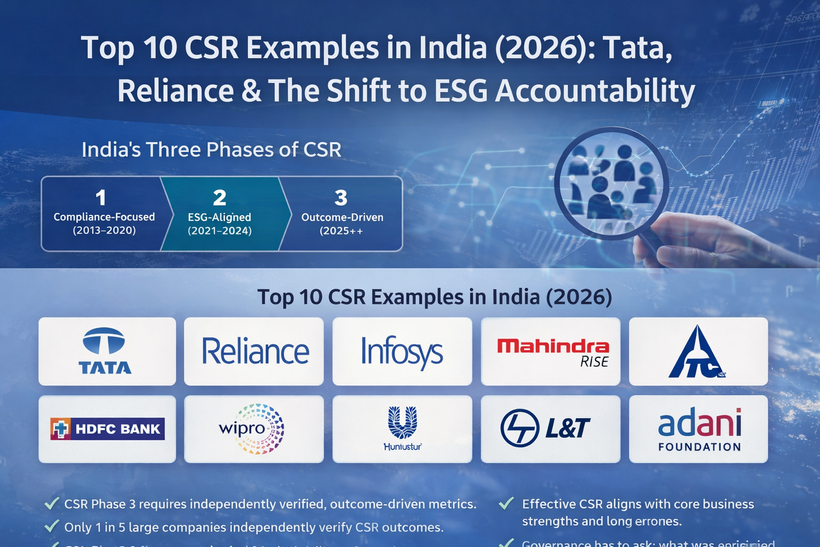
As we move into 2026, the defining shift is clear: CSR is no longer about how much companies spend—it is about what they can prove.
Key Takeaways
- India is entering Phase 3 of CSR, moving beyond compliance toward independently verified, outcome-driven impact aligned with ESG frameworks.
- The biggest challenge is not intent, but a measurement gap—fewer than one in five large companies conduct independent outcome assessments.
- The most effective CSR programs are those that align closely with a company’s core business strengths, not those that operate as disconnected philanthropic efforts.
The Evolution of CSR in India: From Compliance to Accountability
India’s CSR journey can be divided into three distinct phases.
Phase 1 (2013–2020): Compliance-Driven CSR
The introduction of Section 135 mandated that eligible companies spend 2% of their profits on CSR activities. This phase focused on:
- Setting up CSR committees
- Allocating budgets
- Reporting expenditures
While revolutionary, it emphasized spending compliance over measurable outcomes.
Phase 2 (2021–2024): ESG Alignment
The next phase brought:
- BRSR (Business Responsibility and Sustainability Reporting)
- SDG (Sustainable Development Goals) mapping
- ESG disclosures
Companies began aligning CSR with global sustainability frameworks, but most reporting remained narrative-driven and internally verified.
Phase 3 (2025 Onward): Outcome Accountability
India is now entering a new era where CSR must deliver:
- Independently verified outcomes
- Longitudinal impact tracking
- Climate-integrated and ESG-aligned results
The central question is no longer whether companies invest in society—but whether that investment leads to real, measurable change.
Why CSR Accountability and ESG Scrutiny Are Increasing
Three forces are reshaping CSR into a strategic priority:
1. Investor Scrutiny
Global investors now integrate ESG into valuation models. CSR performance directly impacts:
- Cost of capital
- Market perception
- Investment eligibility
A CSR program without measurable outcomes signals weak management discipline.
2. Stronger Regulatory Frameworks
With SEBI’s BRSR mandate:
- CSR disclosures are becoming structured and comparable
- Sustainability reporting is moving beyond storytelling
Companies are increasingly exposed to regulatory risk if claims lack evidence.
3. Rise of Verification Technology
Technologies like:
- Satellite imagery
- AI-driven analytics
- Third-party audits
are making it harder to sustain a gap between reported impact and actual outcomes.
The Accountability Gap in Indian CSR
One of the most critical insights is the accountability gap—the difference between:
- What CSR reports claim
- What independent verification confirms
Output vs Outcome: The Core Problem
Most CSR reporting focuses on outputs:
- Number of training sessions conducted
- Infrastructure built
- Beneficiaries reached
But outputs are not impact.
Outcomes measure real change, such as:
- Increased income
- Improved health
- Better education results
The shift from output to outcome is the defining challenge of modern CSR.
Top 10 CSR Examples in India (2026)
These organizations represent the diversity, ambition, and challenges of CSR in India today.
1. Tata Group – When Philosophy Must Meet Proof
Tata’s CSR is deeply embedded in its structure through Tata Trusts and long-standing institutions.
Strength:
Institutional, long-term, deeply integrated approach
Challenge:
Even legacy impact must now be independently verified and measured longitudinally
2. Reliance Foundation – The Scale Trap
Reliance has demonstrated unmatched ability to mobilize resources, especially during crises like COVID-19.
Strength:
Execution at national scale
Challenge:
Scale often measures reach—not transformation. The focus must shift to sustained outcomes
3. Infosys Foundation – Governance as a Ceiling
Infosys leads in governance, compliance, and reporting standards.
Strength:
Strong governance, audits, and transparency
Challenge:
Governance must translate into measurable social outcomes
4. Mahindra (Nanhi Kali) – Power of Focus
Mahindra’s focus on girl-child education shows the power of concentrated investment.
Strength:
Deep, structured intervention in a single domain
Challenge:
Need for lifecycle tracking of beneficiaries beyond schooling
5. ITC – Strategy Integration at Scale
ITC’s sustainability initiatives (carbon-positive, water-positive) are integrated into business strategy.
Strength:
Alignment of sustainability and business performance
Challenge:
Future demands include externally verified climate and ESG metrics
6. HDFC Bank (Parivartan) – The Digital Inclusion Gap
HDFC aligns CSR with financial inclusion and banking infrastructure.
Strength:
Strong alignment with core business
Challenge:
Must evolve toward digital financial literacy in an AI-driven ecosystem
7. Wipro Foundation – The Invisible Work Problem
Wipro focuses on systemic interventions like education reform.
Strength:
Deep systems-level thinking
Challenge:
Impact is difficult to measure and communicate within standard ESG frameworks
8. Hindustan Unilever – Expertise as Legitimacy
HUL’s hygiene programs leverage its domain expertise.
Strength:
Category expertise + distribution reach
Challenge:
Must prove impact beyond brand promotion perception
9. L&T Skill Forge – Right Strategy, Changing Reality
L&T’s vocational training aligns with India’s infrastructure needs.
Strength:
Direct alignment with national skill gaps
Challenge:
Rapid technological change risks skills obsolescence
10. Adani Foundation – Proximity vs Transparency
Adani focuses on communities near operational zones.
Strength:
Localized, place-based intervention
Challenge:
Requires independent verification to ensure credibility in ESG-driven scrutiny
What Good CSR Actually Looks Like
A global benchmark suggests CSR should follow a cycle of:
- Hypothesis
- Measurement
- Evaluation
- Continuous improvement
In contrast, traditional CSR follows:
- Spend → Report → Repeat
India’s future lies in adopting the learning loop model, where programs continuously evolve based on evidence.
What Distinguishes Excellence from Compliance
Three patterns separate high-impact CSR from average efforts:
1. Strategic Alignment
Programs that leverage core business strengths are:
- More credible
- More scalable
- More impactful
2. Focus Over Dispersion
Concentrated efforts produce:
- Deeper outcomes
- Stronger accountability
3. Long-Term Commitment
Sustainable impact requires:
- Multi-year investments
- Longitudinal tracking
- Iterative improvement
The Board’s Role: Accountability Starts at the Top
CSR failure is ultimately a governance failure.
Boards must move beyond compliance and ask:
- What outcomes did we achieve?
- What failed—and why?
- Who verified our impact?
Without this shift, CSR remains a checkbox exercise.
Six Questions Every CSR Committee Must Ask
- Can we track outcomes years after program completion?
- Who independently verified our impact?
- What did we fail to achieve last year?
- Is our CSR aligned with our core expertise?
- Which programs would survive budget cuts—and why?
- Are CSR and ESG disclosures consistent?
These questions define true accountability.
The Future of CSR in India
India pioneered mandatory CSR. Now it must lead the world in measurable CSR.
The next phase will require:
- Independent verification
- Outcome-based metrics
- ESG integration
- Data-driven reporting
The shift is already underway. As ESG scrutiny intensifies and verification tools become more sophisticated, the gap between claimed impact and real impact will continue to close.
Conclusion: From Spending to Proof
India’s CSR ecosystem is not failing—it is evolving.
The companies highlighted here are not just examples of success; they are case studies in transition. They show that intent and investment are no longer enough.
The future belongs to organizations that can:
- Measure what matters
- Prove what they claim
- Align impact with strategy
Because in the next phase of CSR, credibility will be the ultimate currency.